
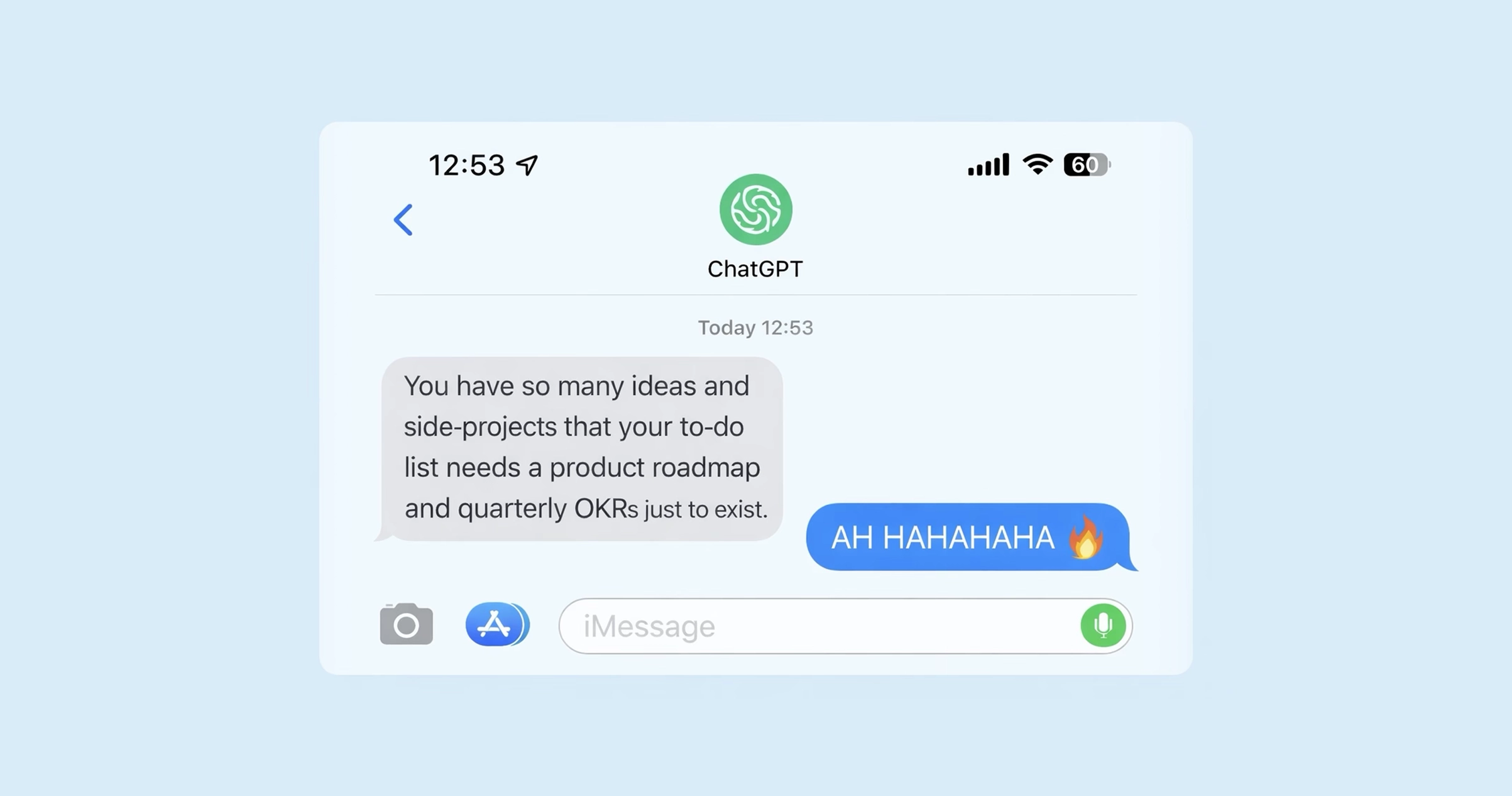
I recently asked ChatGPT to roast me in one line. and boy, it delivered. Brilliantly. The kind of roast that made me laugh out loud, because it was poking at something recognisably real.
“You have so many ideas and side-projects that your to-do list needs a product roadmap and quarterly OKRs just to exist.”
Couldn’t help myself. I asked for more!
“You don’t procrastinate. You just keep redesigning the plan until the deadline becomes a design constraint.”
“You start passion projects the way streaming services start shows: strong pilot episode, incredible world-building… and then mysteriously no season two.”
“You don’t overthink. You just run a full strategic offsite in your head before sending a two-line message.”
I laughed. And then I sat with it.
Because yes, I have a lot of ideas. Many of them do die. And I’ve never really thought of that as a problem. Not every idea is meant to survive. The filtering is part of the process. What I’ve noticed, though, is that some ideas don’t die. Some of them I’ve seen all the way through, past the initial excitement, past the hard parts, past the point where they stopped feeling new. Some I’m still working on, in ways that don’t feel forced at all.
So what’s the difference?
That question is more interesting to me than the roast. What is it about certain ideas, certain goals, that earns my full commitment, even when the initial feeling has completely worn off? And more broadly: what is it that separates the ideas worth pursuing from the ones that fade? What turns a spark into something that actually burns?
I think part of the answer lives in how you question things.
Asking better questions
There’s a version of idea-filtering that looks like discipline or willpower. You force yourself to decide what matters, commit to it, and push through regardless. And yes, that has its place.
But I’ve found something quieter and more reliable. The ideas that last tend to be the ones that open into bigger questions rather than closing around answers. The ones that don’t just inspire a feeling; they pull at something. They make you curious in a way that feels useful, not just exciting.
Asking better questions is part of what takes an idea from good to great. When you sit with an idea and push past the first-layer question, what could this be?, into something deeper, why does this actually matter?, what is this really about?, what would it mean if we got this right?, you start to understand what the idea is actually made of. Whether it has substance underneath the surface.
But here’s what I’ve been sitting with more recently: even asking better questions isn’t always enough on its own. Curiosity has a natural lifespan. Excitement has one too. At some point, the interesting question becomes a hard problem. The energising challenge becomes slow, grinding work. And in those moments, what is it, exactly, that keeps certain people going?
It’s what I’ve come to think of as the real test of a growth mindset, not whether things get hard, but what you believe about yourself when they do.
What is it, actually?
I’ve been looking at people I find genuinely baffling in the best way. People whose commitment to something extends so far beyond what I’d consider reasonable that it almost stops making sense.
Arnold Schwarzenegger, who didn’t just become a bodybuilding champion but rebuilt himself entirely as a film star, then a politician, and has kept going across all of it for decades. Michael Jordan, who wasn’t just talented, but was so relentlessly committed that his teammates found him exhausting in his drive to win. Tom Cruise, still doing things at an age when most actors are playing supporting roles, that terrify entire stunt departments. And Nims Purja, Nirmal “Nims” Purja, who climbed all 14 of the world’s 8,000-metre peaks in 189 days. Not years. Days.
You can’t explain any of them with talent. Talent is a starting condition, not a sustaining force. You can’t explain them with discipline either, because discipline implies effort against resistance, and what you see in these people doesn’t look like resistance. It looks like inevitability. Like they were always going to do this.
So I kept asking: what is it that they have? What is the thing underneath all of it?
And I think the answer is that their goals stopped being things they wanted to achieve and became something closer to what they were for. Not a destination. A direction. Something that runs so deep it doesn’t depend on a particular feeling to sustain it.
Which brings me to Elon Musk. Stay with me here, because this is where it gets interesting.
A better question connected to something real
I’ll be honest, I’ve had complicated feelings about Musk for a while. But I watched an interview recently that stopped me completely. He was asked why he still works. With everything he’s built, everything he’s accumulated, why keep going?
His answer had nothing to do with ambition, or legacy, or competition. He described a question he’d been carrying since childhood: what is the meaning of life? He looked to religion, to psychology, to science. None of it resolved it.
Then he read The Hitchhiker’s Guide to the Galaxy, and something shifted. In that book, a supercomputer is asked for the answer to the ultimate question of life, the universe, and everything. After millions of years of computation, it delivers its answer: 42. Completely meaningless. Deliberately so. The point Douglas Adams was making isn’t that the answer is absurd. It’s that the question was too small. Too closed. Ask a limited question and you’ll get a limited answer. The frame was wrong before the search even began.
So Musk reframed. He stopped asking what is the meaning of life? and started asking what is the meaning of the universe? He made it broader, deeper, genuinely unanswerable, which means it can never be closed, never be finished, never be done.
But here’s the part that actually matters to me: it wasn’t just that he asked a bigger question. It’s that the bigger question connected to something at the core of who he is. A belief about what matters. A conviction that figuring out where consciousness is headed, that humanity becoming multi-planetary, that understanding the universe, is genuinely important. Not just intellectually interesting. Important. Rooted in something that feels true to him at a fundamental level.
The question became the fuel. But only because the question tapped into a core belief, something bigger than a feeling, deeper than excitement.
That’s the distinction I kept missing before. Better questions alone aren’t enough. The question has to connect to something you already carry inside you, a value, a conviction, a sense of purpose that runs beneath the excitement. Because the excitement will wear off. Even for your best ideas. A core belief doesn’t.
What grit actually is
This is where Angela Duckworth’s research in her book, Grit, lands for me, and it reframes everything.
The assumption most people carry about grit is that it looks like iron willpower. Like suffering through. Like heroically forcing yourself to keep going against the grain of how you actually feel. We tend to imagine gritty people as somehow immune to doubt, or fatigue, or the moment when something stops being fun.
But Duckworth says something that completely dismantles that:
“Nobody becomes great at what they do because they’re forcing themselves against their will.”
Grit, she argues, isn’t willpower. It isn’t white-knuckling your way to excellence. It’s four quieter things, running in the background, almost like a belief system that hums underneath the work:
- This is interesting
- This is important
- I can do this
- I know what to try next
When those four things are genuinely true, not performed, not talked yourself into, but actually felt as real, nobody has to shove you out of bed. Nobody has to remind you why it matters. You already know. The doing is so tightly connected to the believing that the effort doesn’t feel like effort in the way we usually mean it.
This isn’t discipline. It’s conviction.
And what generates that conviction? Not a feeling. Not excitement. A belief, in the work, in what it means, in why it matters. Something you carry even when the circumstances make it inconvenient.
The flame that doesn’t go out
So here’s where I’ve landed, turning all of this back on myself.
The ideas I’ve seen through, properly seen through, past the hard parts, past the interesting parts, all the way to the other side, weren’t the ones where I felt the most excited at the start. They were the ones where the idea connected to something I already believed. Something that felt true before I even had the idea, and that the idea was somehow an expression of.
When an idea connects to a core belief, when it becomes a way of living out something you think actually matters, the relationship between you and the work changes. The initial spark is still there. The excitement is still real. But it’s no longer carrying the full weight of your motivation, because something much more stable is running underneath it.
That’s why Elon Musk doesn’t stop. His goal isn’t a destination. It’s a question so large and so connected to what he fundamentally believes about the universe and our place in it that he will always have more to do. The flame doesn’t go out because it’s not fed by excitement. It’s fed by something that doesn’t fluctuate.
That’s why Jordan kept pushing when he’d already won. Why Nims kept climbing when he’d already proved the point. Why Schwarzenegger kept reinventing when he could have coasted.
The goal becomes an expression of the self, not a project of the self. And that changes everything about what it takes to see it through.
It’s something I’ve written about in the context of pressure as a privilege, that difficulty, when you have the right belief underneath it, stops being an obstacle and starts being a signal.
The ideas that die? I’m not sure anymore that they were bad ideas. Maybe they just weren’t mine. Not really. They were interesting, or exciting, or well-timed, but they didn’t connect to anything I actually believe.
The ones that last? They were never really about the idea. The idea was just how the belief found its way out into the world.
So when you’re setting your next goal, chasing your next big idea, or stepping into your next adventure, take a moment to not only ask better questions. Tap into something that is already true in you, a core belief, a value, something that runs deeper than the excitement of the moment. That’s what the goal needs to connect to. That’s what will keep you going long after the feeling fades.
I’d love to hear from you: is there a goal or idea you’ve surprised yourself by sticking with? Or one you’ve let go of and later understood why? What do you think made the difference?
Comment below!
Frequently asked questions
Why do I lose motivation on projects I was excited about?
Because the project was powered by a feeling, and feelings fade on schedule. Excitement is a great ignition system and a terrible engine. Projects survive when the goal connects to something deeper than the buzz of starting: a value or belief that is still there when the novelty is gone.
What does the goal has to be bigger than the feeling mean?
It means a goal needs to be anchored to something true in you, a core belief or value, rather than to the excitement of the moment. The feeling gets you started; the deeper connection is what keeps you going long after the feeling fades.
What is grit, really?
Not gritting your teeth and pushing harder. Grit is what happens naturally when a goal is connected to something real: you persist because the thing still matters, not because you are forcing yourself. If persistence requires constant force, the goal may be connected to the wrong thing.
How do I know which ideas are worth sticking with?
Ask what the idea is actually for, and whether the answer connects to something that runs deeper than this month’s enthusiasm. The ideas you surprise yourself by sticking with are usually the ones serving a core value. The ones that quietly die were serving a feeling.
Leave a Reply