

Everyone in tech is “using AI” now, which is a bit like everyone saying they’re “using electricity.” It’s true, and it tells you almost nothing. Some teams have a chatbot tucked in a corner of a product. Some have quietly rewritten how their entire company ships software. Both stand up in the all-hands and say the same sentence.
I’ve spent the last stretch actually building AI systems rather than just having opinions about them, which is the only reason I trust what I’m about to say. The gap I kept noticing between the companies I admired and everyone else was real, but nobody could tell me exactly what it was made of. So I went and looked.
I studied around ten operators, practitioners, and AI-native founders. Not the marketing version of their story, the operating version. I wanted the pattern underneath the noise: what actually separates a company that has changed how it works from one that has bought some tools and told a good story about it.
The pattern was sharper than I expected. This is not a tooling upgrade. It’s a factory rebuild, and most companies have not started one.
Table of contents
Why “using AI” stopped meaning anything
The trap is cosmetic AI. A summary button here, a chat panel there, a launch post that uses the word “intelligent” four times. It feels like progress because something visibly changed on the surface. Underneath, the model of how work happens has not moved at all. The same people do the same work in the same order, now with a helpful widget nearby.
That is not a small problem you can polish away later. It’s a strategic one. When AI is decoration, your moat does not deepen, your customers do not get a different outcome, and you have spent real money to stand still while telling yourself you are moving.
The companies pulling ahead are not the ones with the most AI features. They are the ones who understood that the org chart, the culture, and the architecture all have to change at once, because you genuinely cannot do one without the others.
The four phases, from cosmetic to compounding
The reason I mapped this into phases rather than a list of recommendations is simple. You cannot sequence what you cannot locate. Every struggling team I studied had skipped straight to buying things before they understood where they actually stood.
Phase one: AI-washed
Cosmetic AI, marketing rather than transformation. The core has not changed and customers are not getting different outcomes. It’s a deathtrap dressed as a standing start, because it feels like you have begun when you have not. Most of the market that claims to be “using AI” is sitting right here.
Phase two: AI in core workflows
The agent completes real tasks, and the human reviews and handles the exceptions. This is the first phase where the work itself is different, not just faster, and where the moat begins to deepen because the system learns from usage.
Phase three: agents as product
Systems reason, plan, and execute end to end, and the human governs rather than directs. Software stops being a tool you operate and starts behaving like a business partner. The internal factory a company built to get here quietly becomes the external product.
Phase four: cross-customer learning
Every interaction makes the system smarter, and that learning compounds across the whole customer base. The market stops being seats and starts being the value of the work itself.
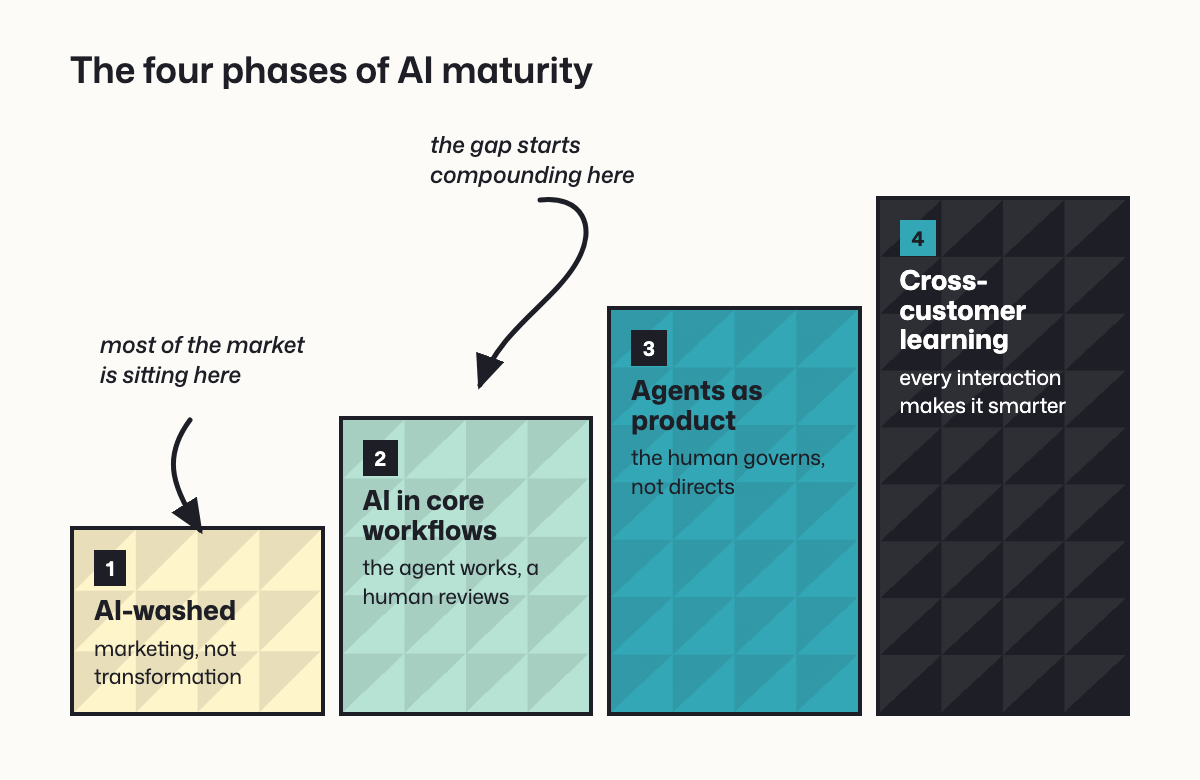
The uncomfortable part is the spread. The gap between the companies at phase two and above and everyone else is widening quickly, and it compounds. This is not a race where the back of the field catches up on the next lap.
What separates the companies pulling ahead
None of it was about which model they picked.
The clearest finding, and the one most teams get backwards, is that documentation and specification quality determine output quality, not model selection. Every serious practitioner arrived at this independently. Agents succeed when the spec is precise and fail when it’s vague. The bottleneck has moved from writing code to writing context. If your agents are wandering, the fix is upstream in the brief, not in switching models. It’s the same lesson Nielsen Norman taught a generation of designers about requirements, wearing new clothes.
The next one surprised me less as I sat with it: the internal harness is the product before it’s the product. The cloud dev environments, the traces and evals, the orchestration spine a company builds to move fast internally is the same foundation its customer-facing AI is later built on. Internal infrastructure and external product share one stack. I’ve since written a whole piece on what a harness actually is, and why it matters more than the model, because it turned out to be the most underrated skill in AI this year.
And the least technical finding was the most decisive. The cultural mandate has to come from the top, non-negotiably. At the fastest company in the study, the CEO owned the shift directly and made adoption non-optional. Several engineers left. That was not incidental, it was the price of the change. Where the mandate is optional, or delegated to a VP, the transformation stalls.
So how do you tell which phase you’re in?
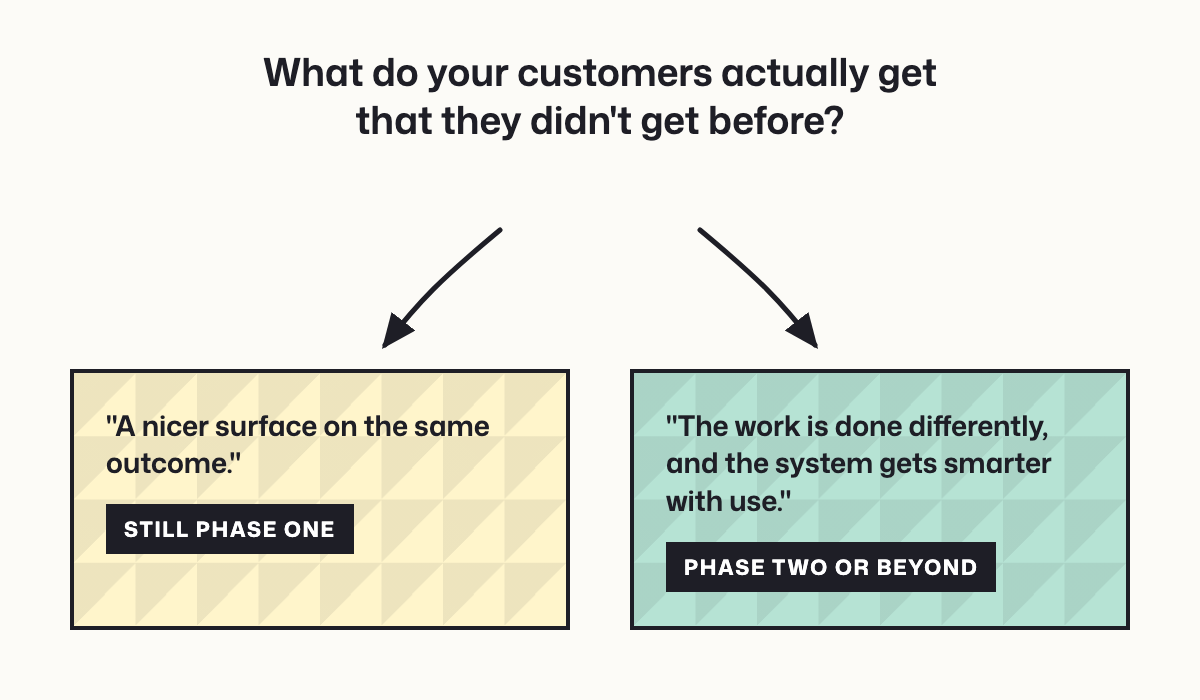
Ask what your customers actually get that they didn’t before, not what you shipped. If the honest answer is a nicer surface on the same outcome, you’re still in the AI-washed phase, whatever the roadmap says. If the work itself is now done differently, and the system gets smarter with use, you’ve reached phase two or beyond.
It’s a deliberately uncomfortable question, because it strips out the theatre. A chatbot is easy to point at in a demo. A changed outcome is not.
The thing I underestimated when I started was how much of this is a willingness problem rather than a capability problem. Every company in the study had access to the same models. What separated them was whether leadership was prepared to rebuild the factory rather than redecorate the shop floor, and to pay the real cost of that in roles, habits, and sometimes people.
I came into this thinking the interesting question was technical. I left convinced it’s organisational. And design, which spends its whole life at the seam between how a thing works and how people actually use it, has more to say about that than we usually claim.
If this resonated, I’ve written about the same shift from the designer’s side in why “should designers resist AI” is the wrong question, and about what changes when design stops being about output in design is not what you make.
Frequently asked questions
What are the four phases of AI maturity?
They run from cosmetic AI to compounding intelligence. Phase one is AI-washed, meaning surface features with no real change underneath. Phase two puts AI into core workflows with a human reviewing. Phase three turns agents into the product itself, with the human governing. Phase four reaches cross-customer learning, where every interaction makes the whole system smarter.
Why do most companies get stuck in the AI-washed phase?
Because cosmetic AI feels like progress. Adding a chatbot or a summary button changes the surface without changing how work actually happens, so the moat never deepens and customers never get a different outcome. Moving past it means rebuilding how software is made, which is an organisational and cultural change, not a purchase.
Does the AI model you choose matter most for results?
No. Across every advanced team studied, documentation and specification quality determined output quality far more than model selection. The bottleneck has moved from writing code to writing precise context. If agents are producing poor work, the fix is almost always upstream in the spec.
What is the biggest predictor of a successful AI transformation?
A cultural mandate from the very top, treated as non-negotiable. The fastest-moving companies had leadership own the shift directly and make adoption non-optional, even at real cost. Where the mandate is optional or delegated down, the effort stalls.
How can I tell which phase of AI maturity my company is in?
Look at outcomes, not features. If customers get a nicer interface on the same result, you are still in the AI-washed phase. If the work itself is genuinely done differently and the system improves with use, you have reached phase two or beyond.
Leave a Reply