

For most of my career, the fastest route to design leadership was being the best maker in the room. AI quietly retired that route. The leaders who matter now are not the ones who can produce the best work. They are the ones who can tell the difference, and can build a team that can tell it too.
The first design agent I built at Drova was faster than me. Not smarter, not more tasteful, but faster in a way that made a specific part of my job feel suddenly ordinary. It could produce a competent layout in the time it took me to open the file. And I have been opening files for seventeen years.
That was the moment the question got personal. If the thing that used to make someone a senior designer, the craft, the speed, the polish, can be handed to a system, what exactly is a design leader for?
I have watched a lot of designers answer that question badly this year, in both directions. Some are clinging to the craft as if output speed was ever the point. Others have gone the opposite way, cheerfully outsourcing judgement to the tool and calling it leadership. Neither is leading. Both are reacting.
Here is what I think the job actually became.
Table of contents
What actually changes when AI enters the team?
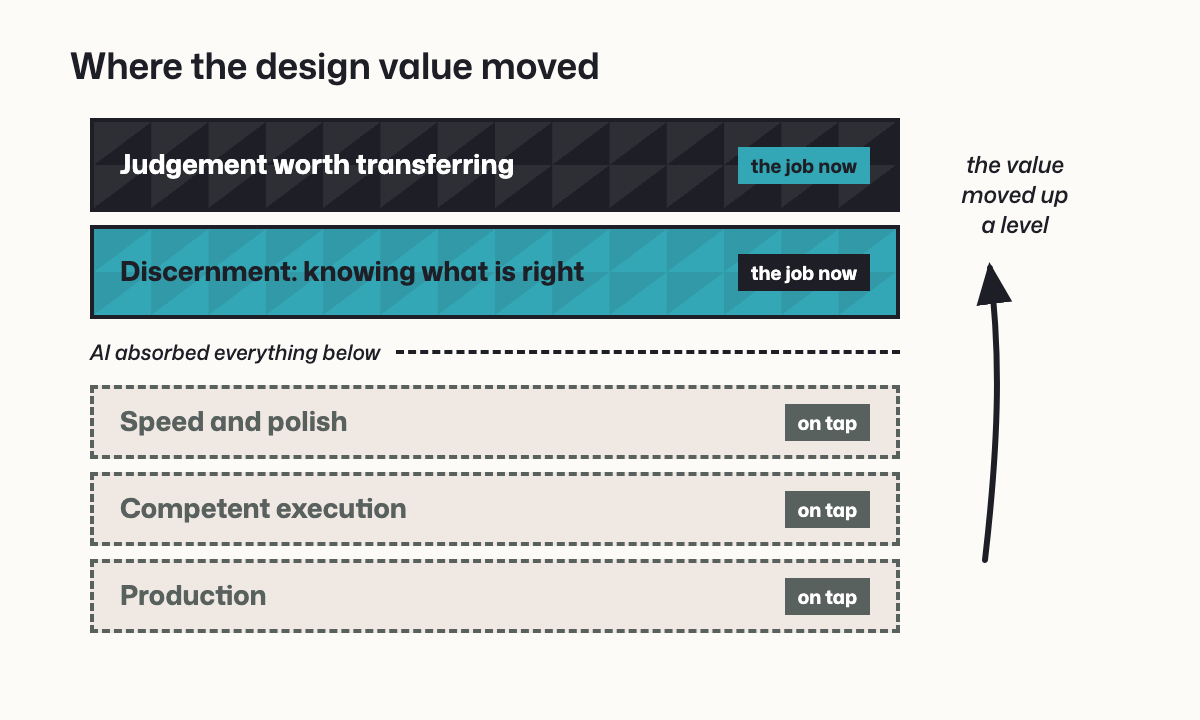
The value moves up a level. When production gets cheap, the scarce skill stops being making the work and becomes knowing which work is worth making, which idea is worth chasing all the way to the end, and what needs to change to take something good and make it right.
For years, the design hierarchy quietly rewarded execution. Juniors made things, seniors made better things faster, and leaders were mostly seniors who had also learned to run a meeting. Craft was the ladder. You climbed it by getting demonstrably good with your hands.
AI did not flatten that ladder. It moved the value up a level and left a lot of people standing on the rungs that used to matter. The competent execution that used to separate a mid-level designer from a junior is now available to anyone who can write a decent prompt. What is not available on tap is discernment: looking at a hundred plausible options and knowing which one is right for this audience, this brand, this moment, and knowing what to change when the right one is not there yet. Ruling out the wrong answers is the easy half. The skill built over years is recognising the right one, often before it fully exists.
That is the shift in one sentence. A design leader’s job is no longer to make the best work in the room. It is to know what great looks like, and to help everyone else see it too.
The skills that got you promoted are the ones AI does now
This is the uncomfortable bit, so I will say it plainly. A lot of what earns a designer a leadership title is exactly what AI is now good at. Producing clean, on-trend, technically correct output. Moving quickly. Covering a lot of surface area. If your reputation was built on being reliable and fast, the ground under that reputation has shifted.
I felt this myself. I have always been proud of being someone who could just make the thing. When I briefed one of our design agents the way I would brief a capable mid-level designer and it handed back competent, generic, not-quite-us work, my first instinct was to blame the tool. It took me an embarrassingly long afternoon to admit the tool had done exactly what I asked.
My value was never the making. It was the thousand small judgements I was making without noticing, the tiny course-corrections that quietly turned something fine into something right. None of them had made it into the brief, because I had never had to say them out loud. That is the part worth holding onto. The making is now shared. That instinct for what the work actually needs is still yours, and it is the whole game.
I wrote about that gap in more detail in how AI is changing the design brief, because briefing turned out to be where a leader’s judgement either survives translation or evaporates. But the deeper point is about identity. If you built your seniority on execution, AI has not threatened your job. It has threatened your story about why you deserved it. The leaders who adapt are the ones willing to update that story.
Taste becomes the leadership skill
When anyone can generate a hundred options, the person who can look at the hundred and confidently pick the one is worth more than the person who made them. That skill has an unfashionable name. It is taste, and it is finally being priced correctly.
Taste is not decoration. It is compressed judgement: the accumulated sense of what is right for this audience, this brand, this moment, held so deeply that you can apply it in seconds without being able to fully explain it. It is the least automatable thing designers own, precisely because it comes from having lived through the work. Julie Zhuo, who led design at Facebook and wrote The Making of a Manager, calls this developing your eye. AI has made your eye the most valuable instrument you carry.
But here is the leadership part, the part that separates a good designer from a good design leader. It is not enough to have taste. You have to be able to transfer it, and this is where I have had to grow.
At Drova I am the only designer. For a long time the design skills were spread across the team, but the judgement, the discernment, the accountability for whether something was actually good, all of that sat with me. I was the quality bar, and I was also the bottleneck. In a startup a bottleneck is the thing standing between you and momentum, so I stopped guarding the taste and started giving it away. I have spent a lot of energy deliberately building up the people around me so that discernment is not something only I can do. The unexpected gift in that is you quickly find out who has a genuine eye for this, who is quietly interested, who wants to grow. Making room for those people has become the part of the job I enjoy most.
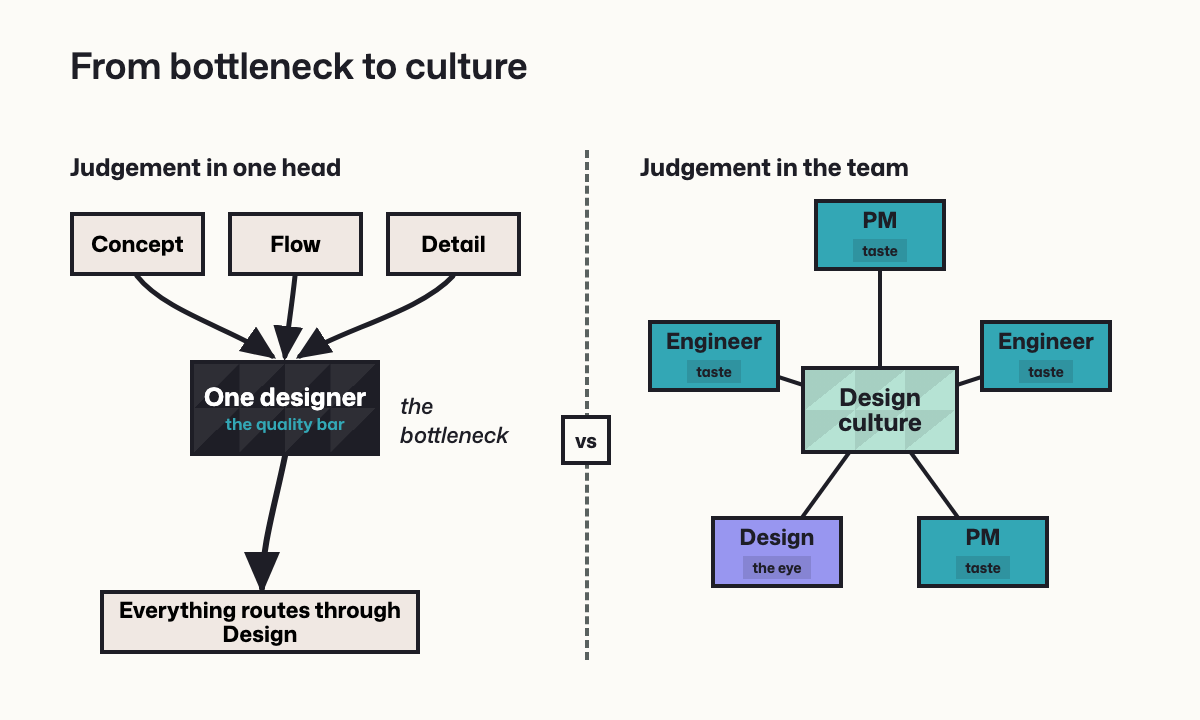
If you are early in your leadership, I know how hard it is to let go of the reins. It feels like lowering the bar. It is the opposite. Once you are through it, you realise that building judgement in other people, rather than hoarding it, is the actual value of leading, and honestly the best part. Taste that stays in your head does not scale. Taste that becomes culture does, and a leader turns their eye into things a whole team can use: a principle, a prototype that sets the vision, a review ritual, a clearly worded standard.
That is the same idea I keep coming back to, that design is not what you make, it is what you make possible. AI just raised the stakes on it.
Leading design when you are the only designer
Here is a detail that shapes everything about how I lead: I am the only designer at Drova. There is no design team to delegate to. The people I lead are product managers and engineers, and my job is to grow design thinking in them, not to hand them finished screens.
In practice that means I build the Claude design skills the team leans on while they design and build, so the design thinking is baked into the tools they already reach for, and I stay close through the whole lifecycle. Sometimes I create a concept prototype to set the vision and the team runs with it. Sometimes a product manager builds the first version and we refine it together. Either way I stay a key stakeholder from concept to shipped, giving regular feedback on how the solution is being designed and implemented, so that UX and taste are honoured and what we deliver is considered rather than merely functional, within the real constraints of the project.
This is why design culture matters to me more than any single deliverable. When you are one person, culture is the only thing that scales you. Every product manager who internalises why a flow should work this way, every engineer who starts noticing the detail that makes an interaction feel right, is design judgement living somewhere other than my head. In an AI world that compounds, because these are also the people directing the tools that generate and build the work. If they carry taste, the output carries it. If they do not, no model will supply it for them.
There is a quieter cultural task underneath all of it. Fear makes people either freeze or overcorrect, and I have written about why designers who resist AI are asking the wrong question. A leader sets the emotional temperature of the people around that fear. Treat AI as a threat and they hide how they use it and learn nothing out loud. Treat it as a toy and they stop taking the craft seriously. The work is holding both truths at once: the tools are extraordinary, and human judgement matters more than ever. Most people cannot hold that tension alone. That is what you are for.
So what makes a great design leader now
Strip it back and it is almost old-fashioned. A great design leader in an AI world is someone with judgement worth transferring and the generosity to transfer it. The tools changed. The definition of leadership got more human, not less.
The craft is not gone. It moved up a level, out of your hands and into your decisions, your standards, and the people you are raising to have their own. The designers who thrive from here are not the ones with the best prompts. They are the ones who know what good is, can say why, and can build a team that recognises it without being told.
Which leaves a question I would genuinely sit with if I were you. When production is free and everyone on your team can make the competent thing, what is the thing only you can still do? Get specific about the answer. That thing is your leadership now.
Frequently asked questions
What makes a great design leader in an AI world?
A great design leader now is defined by judgement rather than output. When AI can produce competent work in minutes, the leader’s value is knowing which work is worth making, recognising when something is genuinely right, and being able to transfer that judgement to the people around them through vision, feedback, and standards.
Is AI replacing design leaders?
No, but it is replacing the reason a lot of people became design leaders. AI absorbs much of the fast, competent execution that used to earn seniority, which means leaders whose value was speed and polish have to rebuild it around judgement, taste, and their ability to develop other people.
What skills do design leaders need in the age of AI?
Taste, or the ability to reliably recognise what is right rather than merely competent, is the core skill, alongside the ability to transfer that judgement so the people around you can apply it too. Practical must-haves include setting a clear vision through prototypes and principles, giving feedback across the whole delivery lifecycle, and growing design thinking in non-designers so taste is not trapped in one person’s head.
How do you lead design when you are the only designer on the team?
You lead by growing design thinking in the people around you rather than delegating to other designers. That means setting the vision with concept prototypes, staying a key stakeholder from concept through implementation, and giving regular feedback so that UX and taste are honoured in what ships. Building a strong design culture is how one designer scales their judgement across a whole product team.
Want to lead the tools well, not just survive them? The Claude Starter Guide comes with a full skills kit on GitHub, including the briefing and review workflows I use to turn design judgement into something a team and its AI can actually run on.
Leave a Reply