
The brief was always a prompt. We just never had to be good at it. For most of my career, a thin brief got rescued by a talented designer filling the gaps with judgement. AI changed that deal. The gaps now get filled with averages, which means the AI design brief has quietly become the highest-leverage artefact a design team produces.
I went digging through my old design briefs recently. And by digging, I mean I cheerfully made it Claude’s problem and went to make a coffee. Seventeen years of them, across brand work, product teams, and design systems. What struck me was not how much they varied. It was how little. Nearly every one described a deliverable. The screen, the page, the campaign, the component. Make this thing, roughly this shape, by this date.
The briefs I write now look nothing like those. Since building an agent-based Design Ops system at Drova, most of what I brief gets consumed by AI before a human ever touches the output. And the AI design brief, if we want to call it that, inverts the old formula. The deliverable is the least important part. Everything I used to leave implicit, the intent, the constraints, the quality bar, is now the whole document.
AI did not kill the design brief. It exposed it.
Table of Contents
How is AI changing the design brief?
AI is shifting the design brief from a description of deliverables to a description of judgement. When a first draft costs minutes instead of days, specifying what to make matters far less than specifying what it needs to achieve, what it must respect, and how you will decide whether it worked.
The old brief was shaped by scarcity. Production was expensive, so the brief existed to protect effort. Pin down the deliverable, agree the scope, prevent the rework. Most of the actual thinking happened after the brief was signed off, inside the designer’s head, and nobody minded because that thinking was what you were paying for.
That economics has flipped. Generation is close to free and iteration is instant. This is not fringe behaviour anymore, either. Nielsen Norman Group’s survey of more than 800 UX professionals found that 92% had used generative AI tools, most of them weekly or daily. When everyone on the team can produce plausible output in minutes, the scarce thing is no longer production. It is direction. And direction lives in the brief.
The gap a vague brief used to hide
Here is the uncomfortable part. Vague briefs were always broken. We just had a workforce trained to repair them. Hand a thin brief to a good designer and they interrogate it. They ask why, they push back on the deliverable, they fill every gap with context, taste, and judgement. The brief got the credit. The designer did the work.
A vague brief handed to a good designer gets rescued. The same brief handed to AI gets averaged.
That is not a flaw in the tools. It is how they work. A model fills every unspecified gap with the most statistically typical answer, which is another way of saying the most generic one. Leave the audience implicit and you get output for everyone, which is output for no one. Leave the quality bar implicit and you get the internet’s median taste.
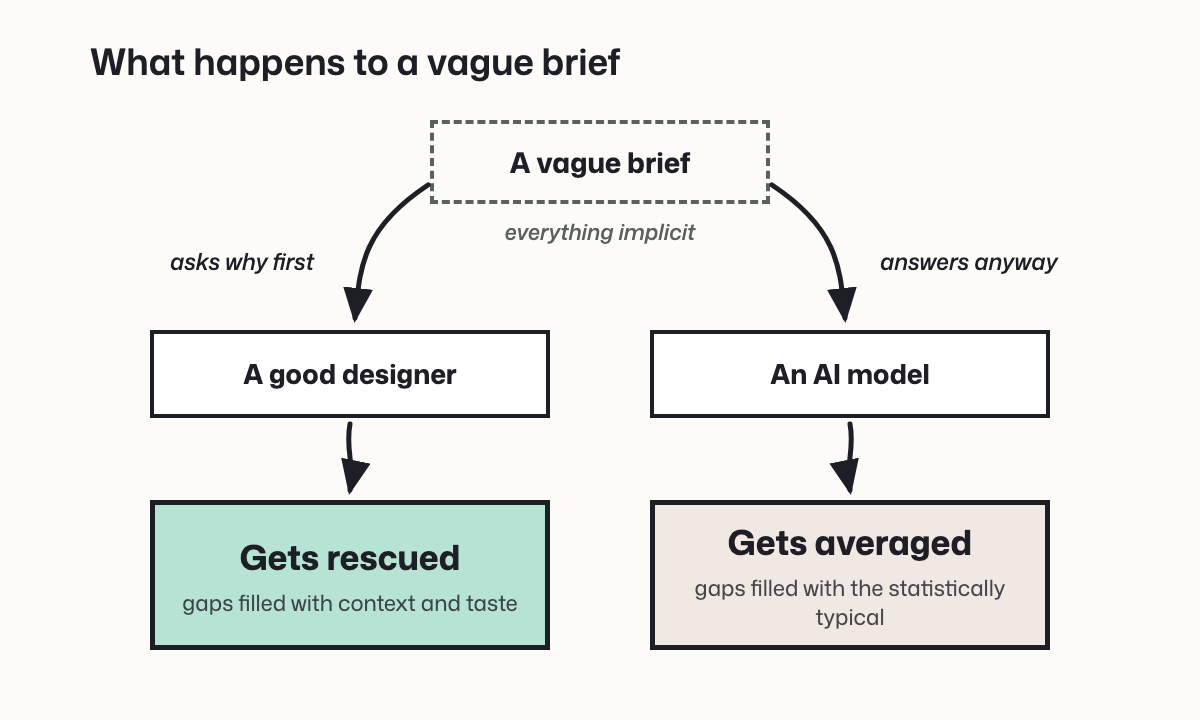
The first time I briefed one of our design agents at Drova the way I would have briefed a capable mid-level designer, the output was competent and completely wrong for us. Not broken. Generic. It had ignored none of my instructions, because the instructions were fine. Everything that made the work ours had been living in my head, not in the brief. The agent had not failed. My brief had.
What should an AI design brief include?
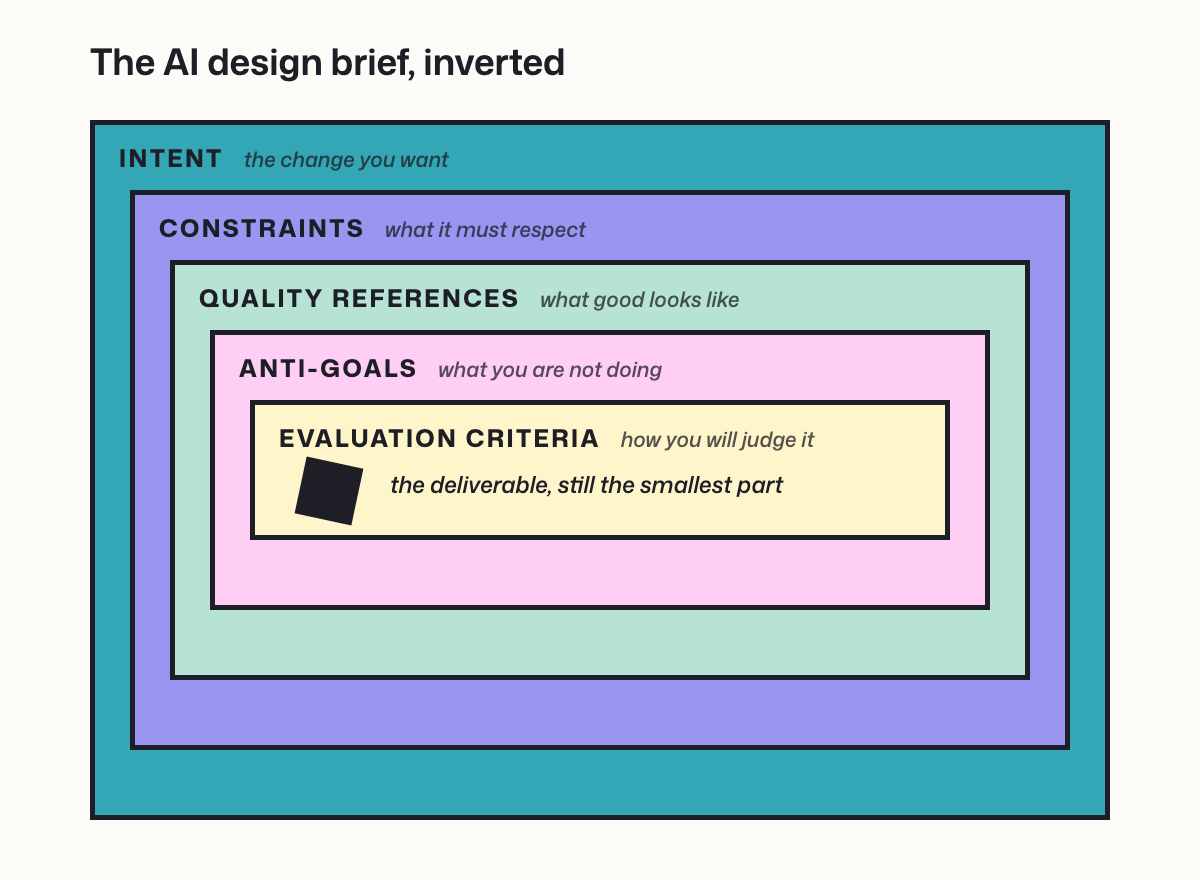
An AI design brief should specify five things: the intent behind the work, the constraints it must respect, references for what quality looks like, the things you are deliberately not doing, and the criteria you will use to judge the output. Deliverables still get named. They just stop being the point.
- Intent. The change you want in behaviour or understanding, not the artefact. “Help a first-time user trust the numbers on this page” briefs very differently to “design an onboarding screen”, even when the deliverable ends up the same.
- Constraints. The design system, the brand voice, the accessibility requirements, the technical realities. Constraints are where consistency comes from now, because nothing else in the pipeline will enforce them for you.
- Quality references. What good looks like, with actual examples. Taste does not transfer by adjective. “Clean and modern” means nothing. Three linked references mean everything.
- Anti-goals. What you are deliberately not doing. AI fills unclaimed space, so claim it first. Half the value of my current briefs sits in the “do not” list.
- Evaluation criteria. How you will judge the output, written before you see it. If you cannot say what you would accept, you are not briefing. You are browsing.
At Drova, I have turned this structure into reusable briefing templates that our design agents consume directly. The brief stopped being a document I write once per project and became infrastructure, which is the same shift I described in design is not what you make, it is what you make possible. The teams getting real output from AI are not the ones with the best tools. They are the ones whose intent survives translation.
What to do about it
Treat brief-writing as design work, because that is what it is now. Hold it to the same standard you hold your interfaces. Draft it, critique it, iterate it. I review briefs in our team the way I used to review screens, and the correlation is direct: the quality of the brief predicts the quality of the output more reliably than the choice of model or tool ever has.
Three habits have made the biggest difference for me. Write the brief even when nobody asks for one, because the discipline of externalising intent pays off whether a human or a machine reads it. Make briefs reusable, because your constraints and quality references barely change between projects and rewriting them from memory is where drift creeps in. And review the brief before you review the output, because most disappointing AI work traces back to an instruction that was never given.
I have written before about why designers who resist AI are asking the wrong question. The brief is where that idea gets concrete. The craft is not disappearing. It is moving upstream, into the thinking we always claimed was the real job. The brief used to be the admin you did before the work. Increasingly, it is the work.
Which raises a question worth sitting with: if your brief is now the highest-leverage artefact you produce, when did you last design one?
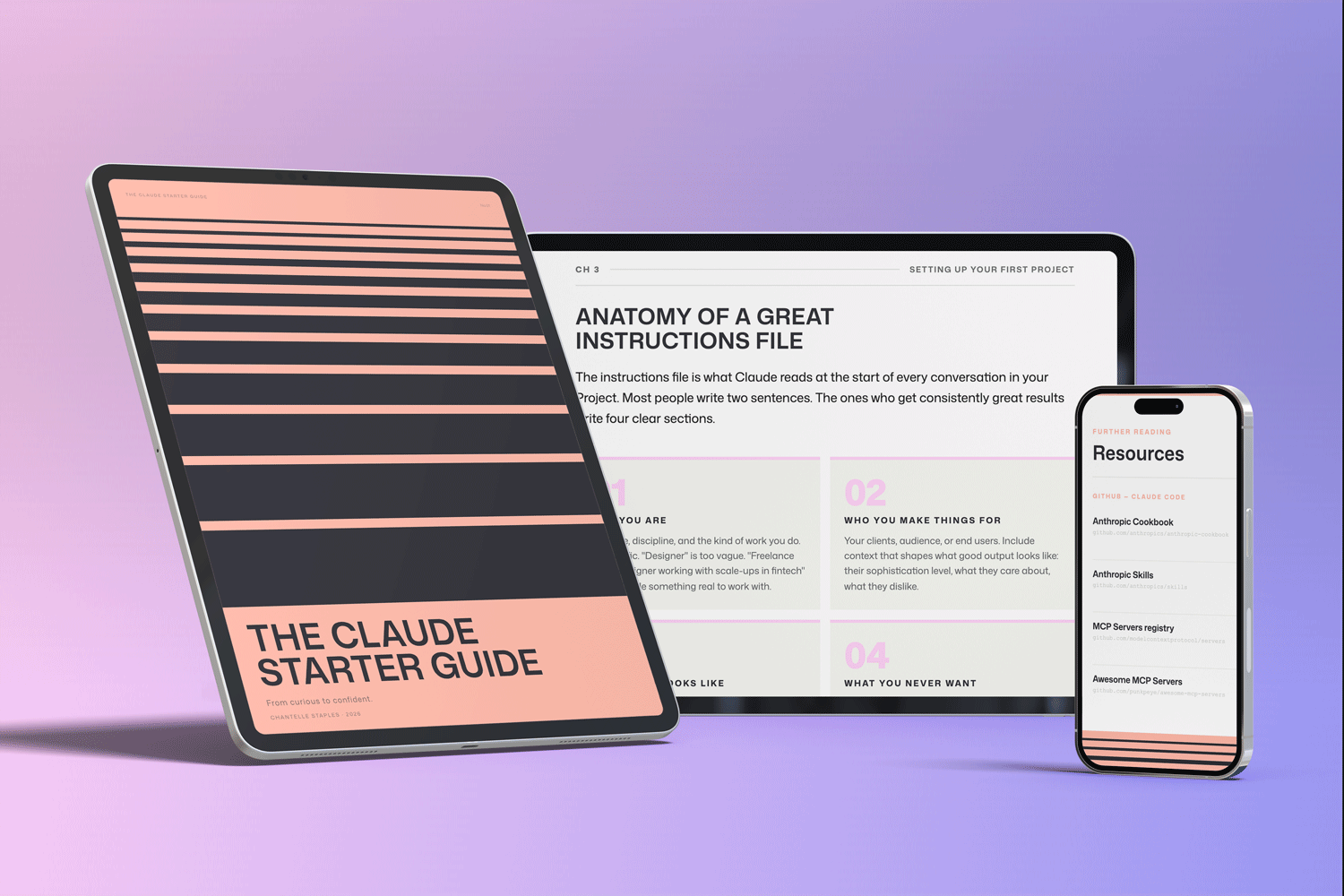
THE CLAUDE STARTER GUIDE
The complete guide to getting started with Claude.
Everything in this post is a workflow you can install. Buying the guide also unlocks my companion GitHub repo, including brief-writer.md, a skill that turns vague requests into structured design briefs.
Pre-built skills for design, product, and marketing. GitHub setup that makes sense. Step-by-step walkthroughs. Every template and workflow from this series, in one download.
Frequently asked questions
How is AI changing the design brief?
AI is shifting the design brief from a description of deliverables to a description of intent, constraints, and quality criteria. Because AI can generate first drafts in minutes, the value of a brief now sits in the judgement it encodes, not the artefact it names.
What should a design brief include when working with AI?
Five things: the intent behind the work, the constraints it must respect, references for what quality looks like, explicit anti-goals, and the criteria you will use to evaluate the output. AI fills any gap with the most statistically typical answer, so anything left implicit gets averaged.
Do designers still need briefs if AI can generate designs?
More than before. Generation without direction produces plausible but generic work, and the brief is where direction lives. As production gets cheaper, the brief becomes the main artefact where design judgement is recorded and transferred.
How is briefing an AI different from briefing a designer?
A good designer interrogates a thin brief, asks questions, and fills the gaps with context and taste. AI fills the same gaps with statistical averages unless you make the implicit explicit. Briefing AI well means writing down the context a human colleague would have absorbed just by being in the room.
Want the brief without the blank page? The Claude Starter Guide comes with the full skills kit on GitHub, including brief-writer.md, the skill that turns a vague request into a structured design brief before the work starts.
Leave a Reply