
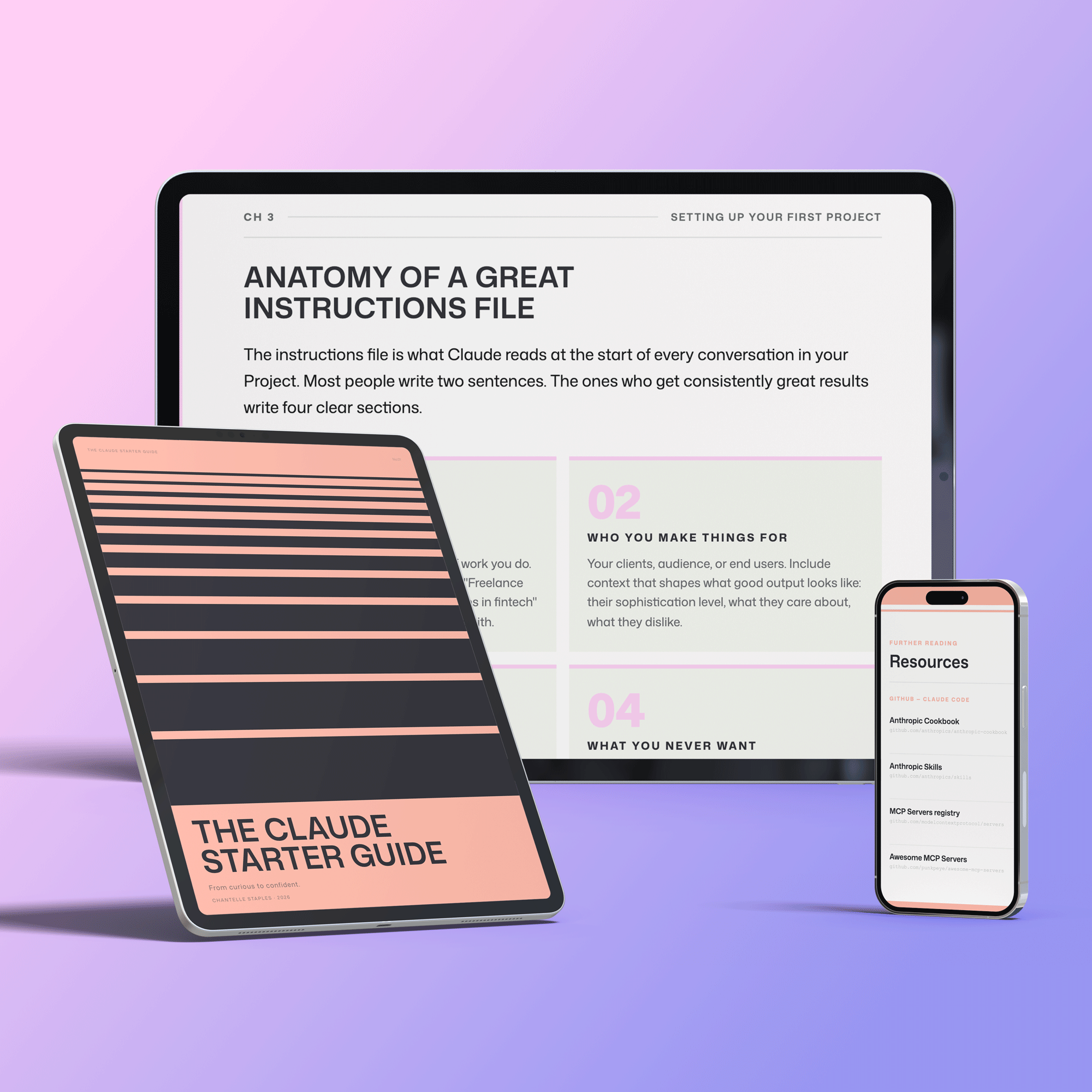
Description
Most people use Claude like a search engine. They type a question, read the reply, and move on. They get occasional useful outputs and no consistent results. This guide is what closes that gap.
The Claude starter guide is a 49-page practical guide for designers, writers, marketers, and creative professionals who want to move past one-off prompts and build a system that works for their specific role.
It covers the mental model you need to use Claude well, a prompting framework that stops mediocre outputs before they start, how to set up a Claude Project that keeps your context loaded so you stop re-explaining yourself every session, what Claude Code actually is (and why non-technical people use it every day), how to write your own skill files so recurring tasks produce consistent results, and how to find and use skills other people have already built.
By the end, you will have a working AI setup built around your actual work, not a generic one.
What is inside
Part One: claude.ai
- Ch 01 – The mental model
- Ch 02 – Writing prompts that work
- Ch 03 – Setting up your first Project
Part Two: Claude Code
- Ch 04 – What Claude Code is
- Ch 05 – Getting started
- Ch 06 – Building your own skills
- Ch 07 – GitHub and other people’s skills
- Ch 08 – Capstone: your full AI setup
Chapter summaries
Ch 01 – The mental model
Why Claude is a collaborator, not a search engine, and the four layers most people never reach: prompts, Projects, skills, and agents.
Ch 02 – Writing prompts that work
The CCSF briefing framework with five before/after rewrites across design, writing, research, strategy, and admin.
Ch 03 – Setting up your first Project
Anatomy of a great instructions file, what reference files to upload, and how to build the compounding effect so you stop re-explaining yourself every session.
Ch 04 – What Claude Code is
A plain-language explanation of what Claude Code does and why non-technical people use it every day.
Ch 05 – Getting started with Claude Code
How to open a folder, write your first CLAUDE.md, and run your first task against files that already live on your computer.
Ch 06 – Building your own skills
What a skill file is, how to write one in four sections, and how to wire it into your setup so recurring tasks produce consistent results.
Ch 07 – GitHub and other people’s skills
How to find, clone, and use skill files others have already built, using GitHub Desktop with no terminal required.
Ch 08 – Capstone: your full AI setup
An audit framework to refine every component you have built and a case study template to make your setup shareable.
The Claude starter kit
The guide comes with the Claude starter kit, a GitHub repository you clone once and use immediately.
20 skill files across four disciplines
Design: design critique assistant, brief writer, UX copy editor, competitive analysis framework, presentation narrative builder
Product: PRD structurer, user story writer, stakeholder update drafter, feature prioritisation reasoner, sprint retrospective facilitator
Marketing: campaign brief writer, LinkedIn post drafter, email sequence builder, SEO brief generator, social media repurposer
Universal (works for any role): meeting notes to actions, research synthesiser, email triage and reply, weekly planning assistant, feedback interpreter
5 copy-paste workflows
- Client brief to proposal
- Feedback session to action plan
- Project kickoff to brief
- Research to insights report
- Weekly content batch
3 reusable templates
- Claude Project instructions file
- Prompt library
- AI Studio case study
Who this is for
Creative and strategic professionals who use or want to use Claude for real work: designers, copywriters, brand strategists, marketers, product managers, and consultants. You do not need to write code. You do not need any prior AI experience.
Format
PDF, 49 pages. Companion repository (Claude Starter Kit) available via GitHub Desktop, no coding required.
Reviews
There are no reviews yet.