
- Role: Creative Director, Character Designer, Copywriter, Content Strategist
- Product: Drova RunSafe, objective-led risk management
- Campaign: In Loving Memory (funeral campaign for Legacy Risk Management)
- My contribution: Character architecture, Greg confessionals, “Oh Register” song and music video, social shorts strategy, full cast expansion, AI production pipeline
View the live campaign: In Loving Memory
The funeral campaign already existed. The concept was sharp: Legacy Risk Management had died, officially, with a coroner’s report, a cause of death, toxicology results, and a reading of the will. The creative team had built something with genuine wit and a strong central premise. The autopsy report was a real designed document. The Breaking News segment was written. The machinery was in motion.
What it didn’t have was someone to love.
That’s not a criticism of the concept. It’s a diagnosis of what any campaign with a strong satirical premise is at risk of: being brilliant and impersonal. The funeral was clever. The audience would read it, nod, feel seen, and scroll on. What I wanted was for them to share it. And people share things when they recognise themselves in someone, not just in a situation.
I pitched Greg.
Not as an idea. I came with a draft music video and two shorts already built. The pitch wasn’t “what if we had a character”, it was “here’s the character, here’s the song, here’s what he sounds like, here’s why it works.” That’s what pitching an AI marketing character looks like in practice. The internal response was immediate: ship it.
The problem
The campaign had a funeral. What it didn’t have was a human being who was grieving.
The risk professionals we were trying to reach had spent years inside the system we were burying. They weren’t villains. They were people who had done the work, built the registers, colour-coded the heat maps, presented to boards who opened to page two and went no further. They had genuine professional identity tied to something the campaign was declaring dead. If the content only showed the absurdity from the outside, it would read as mockery. That’s not shareable. That’s defensible.
The shareable version was the person on the inside, who also found it a little absurd, who was starting to see it too, who said what everyone was thinking but hadn’t admitted yet.
My approach
I didn’t pitch a concept. I pitched evidence.
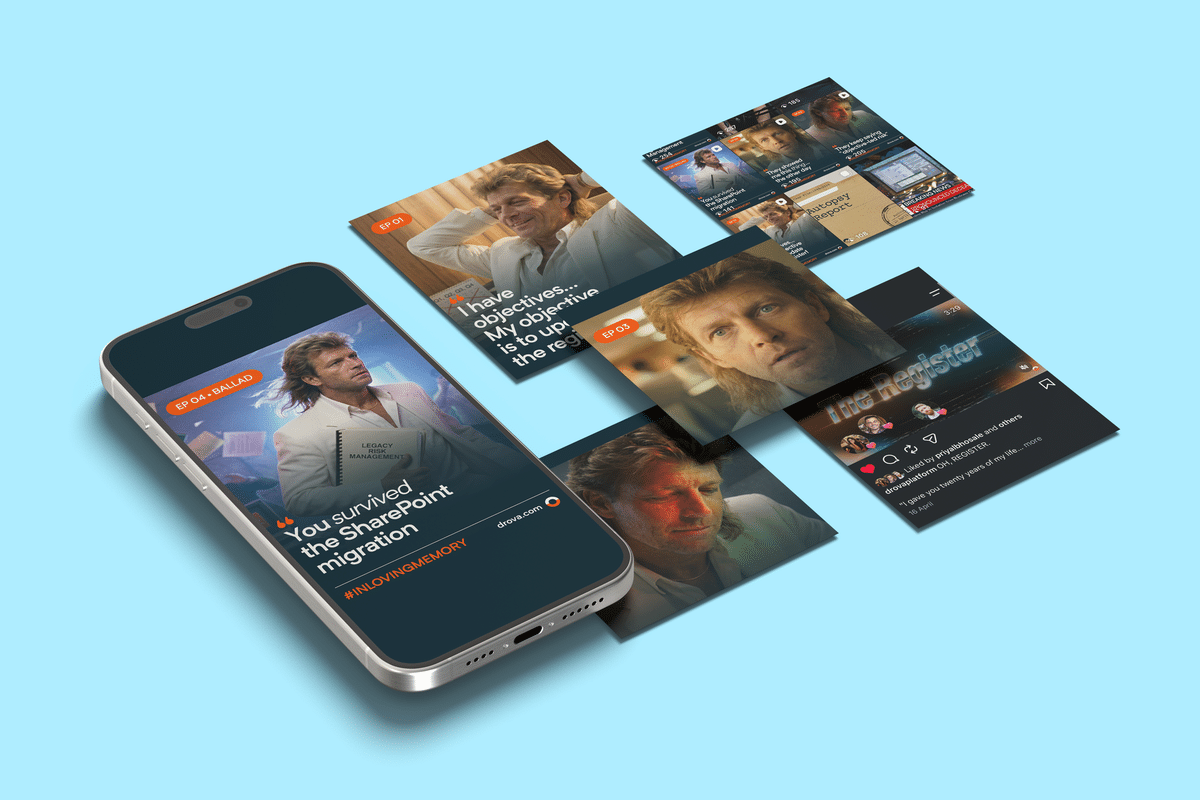
I built the character, wrote the song, produced a draft music video with Luma AI, and cut two Greg shorts before I walked into any conversation about it. That’s not because I was trying to skip the approval process. It’s because an idea about a sad man who loves a spreadsheet is nothing. A sad man who loves a spreadsheet, singing a power ballad to it in a wind machine, in a white linen suit, at a warehouse at the end of a long career: that’s something you can watch.
There was a second reason. I wanted to test authentic reactions, not informed ones. There’s a meaningful difference between showing someone a finished piece of content and asking them to evaluate it, versus showing them a concept deck and asking them to predict how audiences might respond. I treated the internal team as a pilot audience: real people, seeing real content, having real first responses. If they leaned in, the audience would lean in. If they explained why it might work rather than just responding to it, that would tell me something too.
“Ship it” wasn’t just approval. It was the first data point.
The difference between pitching an idea and pitching the thing is the difference between asking people to imagine something and showing them what they’re agreeing to. I’ve stopped pitching ideas.
Greg
Greg is a Senior Risk Manager with twenty-two years of service. He has four thousand, two hundred and eighty-three risk entries. He colour-coded every one of them: red, amber, green. He updates the register quarterly. He has always updated it quarterly. His mug says “I Heart Compliance.”
He is not a caricature. That’s the design decision that makes everything else work. Greg is played completely straight. He loves his register the way other people love things they’ve spent a long time on. His sincerity is real. The comedy isn’t that he’s foolish: it’s that he’s the last person in the building who doesn’t know the thing is over.
His arc across the campaign is the product argument. By Sequence 03, Greg has seen objective-led risk for the first time. Where risks link to what the business is actually trying to do. He watches it. He says, under his breath: “Well that’s… that’s quite good, actually.” Then he defends his register for one more line. Then he admits it. Maybe you don’t need four thousand entries. Especially when all of them don’t connect to anything anyone’s actually doing.
That is the RunSafe value proposition. Not stated by the product. Arrived at by Greg. It lands because he resisted it longest.
One design rule I held throughout: Greg’s suit is white linen. Not cream. Not off-white. White. Established in the first character reference images, confirmed in every production prompt, non-negotiable. Consistency in a character’s costume is consistency in the character’s soul. Greg’s sincerity is in the suit.
Oh Register
“Oh Register” is a power ballad. It is Greg’s elegy, written in the voice of a man who loved a spreadsheet without ever asking what it was for.
The lyrics came from real conversations with customers. Not invented pain points, not assumed frustrations: the actual things risk professionals had said to me about their own registers, their own boards, their own career spent maintaining something no one read. I wrote those conversations into verse structure, which is really just a different kind of framing. The reason it lands is the same reason most good satire lands: it’s funny because it’s true. People laugh at Greg because they’ve been Greg, or they’ve worked next to Greg, or they’ve built a system that Greg would recognise. The song doesn’t exaggerate the problem. It reports it.
The song tracks his twenty-two years: the register’s origins in 1988, three CROs, nine consultants, two board restructures, a dashboard no one dared open. It goes through verse, pre-chorus, full chorus, a key change, and a spoken bridge over quiet piano where his voice breaks slightly. The final chorus is full orchestra.
The hook is a specific number: four thousand, two hundred and eighty-three. It’s not a round number. That’s the point. Round numbers are invented. This one was counted. It appears in verse, chorus, and outro. It is the number Greg knows by heart and the number that proves he was there.
The lyric that does the most work sits in Verse 2: “I never asked what it connected to / I didn’t need to know.” It’s the admission buried inside the affection. Nobody in the song says legacy risk management is bad. Greg demonstrates it, unwittingly, while defending it. The song is the campaign argument with better production values.
The 80s aesthetic wasn’t a stylistic choice. It was a design decision with a specific rationale: the risk register was born in 1988. Greg’s clothing, his environment, the music he inhabits are all frozen at the moment of its creation. He is not just a person who can’t let go of an old way of working. He is visually and sonically the era that produced it. The 80s were also the era of the great love ballad, which made it the only possible genre. Total Eclipse of the Heart. I Will Always Love You. Songs about devotion that survives all rational argument. That’s Greg.
I took this brief into Suno AI with a detailed prompt to achieve the exact sound: “over the top 80s power ballad, think Bonnie Tyler Total Eclipse of the Heart, massive reverb, synths, emotional guitar, a man singing with devastating sincerity.” The precision of that prompt mattered. “Devastating sincerity” is doing a lot of work. It’s not “emotional,” it’s not “heartfelt”: it’s sincere to the point where the sincerity itself becomes the comedy. Suno produced something that landed exactly where I needed it: genuinely moving in the way that 80s power ballads are genuinely moving, which is to say all the way.
Building Greg, an AI marketing character
The music video and shorts were produced across four tools, each handling a different layer of the output.
OpenArt handled Greg’s character design: his avatar, his visual identity, the specifics of his look locked down so that every AI-generated scene could stay consistent. A white linen suit. Dirty-blonde mullet. Light stubble, no moustache. Tanned skin, blue eyes. Desk covered in printed spreadsheets. The mug. Once the character reference was established, every other tool drew from it.
Luma AI generated the scenes: the warehouse, the dramatic backlighting, the register on a pedestal, the wind machine, the neon orange and amber grade that put him in Drova’s brand palette while keeping him firmly in 1987. Each scene brief was written as a detailed prompt, with the visual language of an 80s music video as the reference frame. The goal was always that the production quality served the joke: the more seriously the video takes itself, the funnier Greg’s sincerity becomes.
ElevenLabs handled voice and lip-sync: Greg’s confessionals, his delivery, the timing of every pause and tongue-click. The voice direction I wrote for Greg was specific: never plays it for laughs, the tragedy is real to him. ElevenLabs let me tune that register precisely, testing different deliveries until the sincerity landed without tipping into parody.
Adobe Premiere Pro was the cut. The music video and shorts were assembled there: pacing the edits to the music, pulling the 60-second highlight reel from four longer sequences, making sure each short worked as a standalone piece and as part of the larger arc.
The full production ran without a traditional production team: no camera, no studio, no crew. This AI production pipeline handled what a crew would have, and the creative direction and prompting handled what a director would have. That’s not a boast about the tools. It’s an observation about where the work actually sits when you use them seriously: entirely in the brief.
Expanding the cast
Once Greg was greenlit, the question became what system he could anchor.
A single-character campaign produces one tone. The funeral premise could hold an ensemble: multiple relationships to legacy risk management’s death, each one genuinely different, each one genuinely funny for a different reason.
I designed six more characters. Each one represents a distinct position in the ecosystem:
Dr. Voss is the forensic risk pathologist: German, precise, unreactive. She examines the register the way a real coroner examines a body. She reads “Password1” from the toxicology results. Sets it down. Moves on. She never lands the joke. It lands itself.
DI Graves is the detective who treats the death as a crime scene. Where Voss delivers the medical verdict, Graves builds the case. He gets emotionally invested in a way she never does. His outrage at the obvious is the comedy. He notices the twelve-minute board attendance, the second USB stick, Password1. He squints at risk registers the way other detectives squint at fingerprints.
Felicity Drummond is the BBC News anchor. She has covered coups, natural disasters, four Prime Ministers. She brings the full weight of that experience to a story about a man who loved a spreadsheet. She is never in on the joke. The moment she is, there is no joke. Her catchphrase is two words: “Greg. Thank you.” They contain everything.
Sandra is the new hire from a startup, holding her laptop like a shield, looking at the camera like she’s in The Office. Her question is always: “What are they connected to?”
Legacy is the deceased: a person playing the concept of Managing Risk in Isolation. Aging. Confused. Carrying a clipboard. Wondering why no one visits anymore. “I just wanted to matter.”
Richard is the non-executive director who has never opened the board pack and thinks the dashboard is a website. “Green means good, yes?”
Each character has a different content velocity and platform fit. Greg runs long, Dr. Voss runs cold, Graves runs warm, Felicity runs straight. Together they produce a system that can sustain weeks of daily output without repeating itself, because no two characters are funny for the same reason.
Social architecture
The distribution strategy follows the content: each character has their own stream, each week introduces or deepens one arc.
The 60-second Greg highlight reel, built for Instagram Reels and YouTube Shorts, pulls across all four sequences. Hook: “Objective-led?!” Crack: “If something goes wrong: ‘Well, it was in the register.’ Done.” Revelation: “That’s quite good, actually.” Confession: “Maybe you don’t need four thousand entries. Especially when all of them don’t connect to anything anyone’s actually doing.” Caption: “Four episodes. One man. Twenty years. One register.”
It doesn’t explain the joke. The joke explains itself.
Bringing the company along
A system like this only compounds if the rest of the company understands it. So I took it to Monday Muster, Drova’s fortnightly all-hands, and walked everyone through how the campaign actually got made.
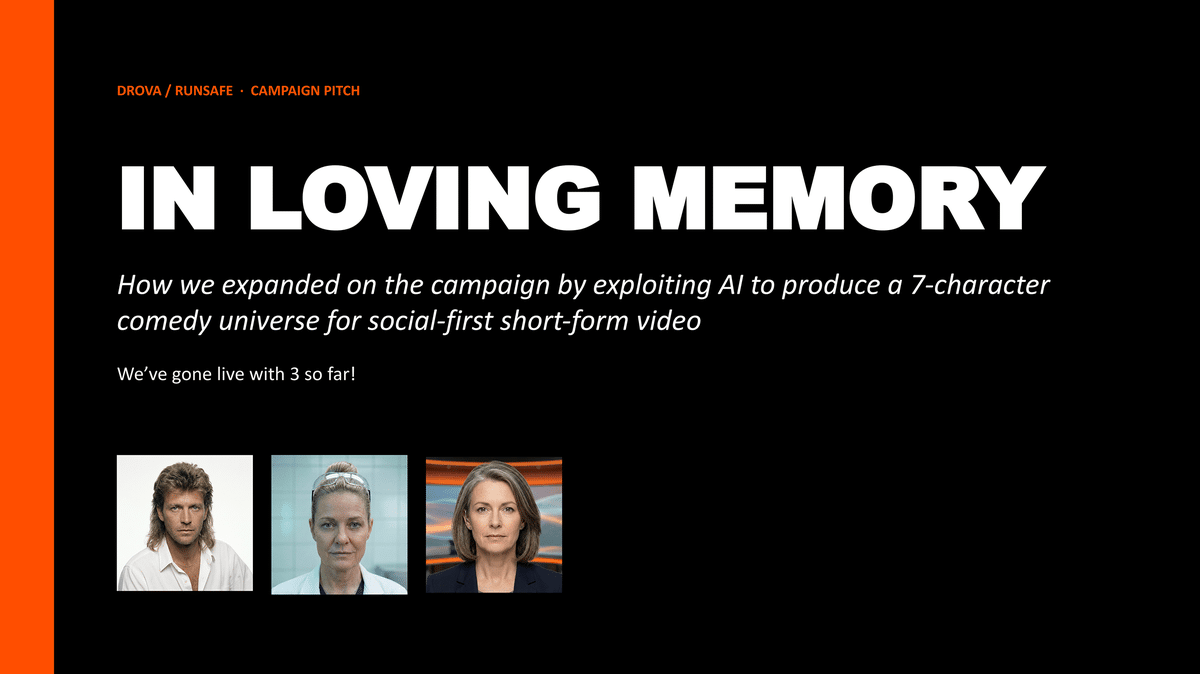
The talk had one honest through-line: we exploited AI. Not as a buzzword. As a specific stack, Luma, Eleven Labs, Suno, and OpenArt, that let a four-person marketing team produce broadcast-style shorts, a fully scored music video, and a seven-character universe in a fraction of the time and cost of traditional ad production. What used to need a crew, a studio, and a post house now needed a brief and a few days.
I also introduced the cast, and made the case for why an ensemble beats a single ad: relatability, serialised content, contrast. Then the part that matters most to a team measured on output, the endless remix potential. One character becomes a dozen posts. One campaign seeds the next.
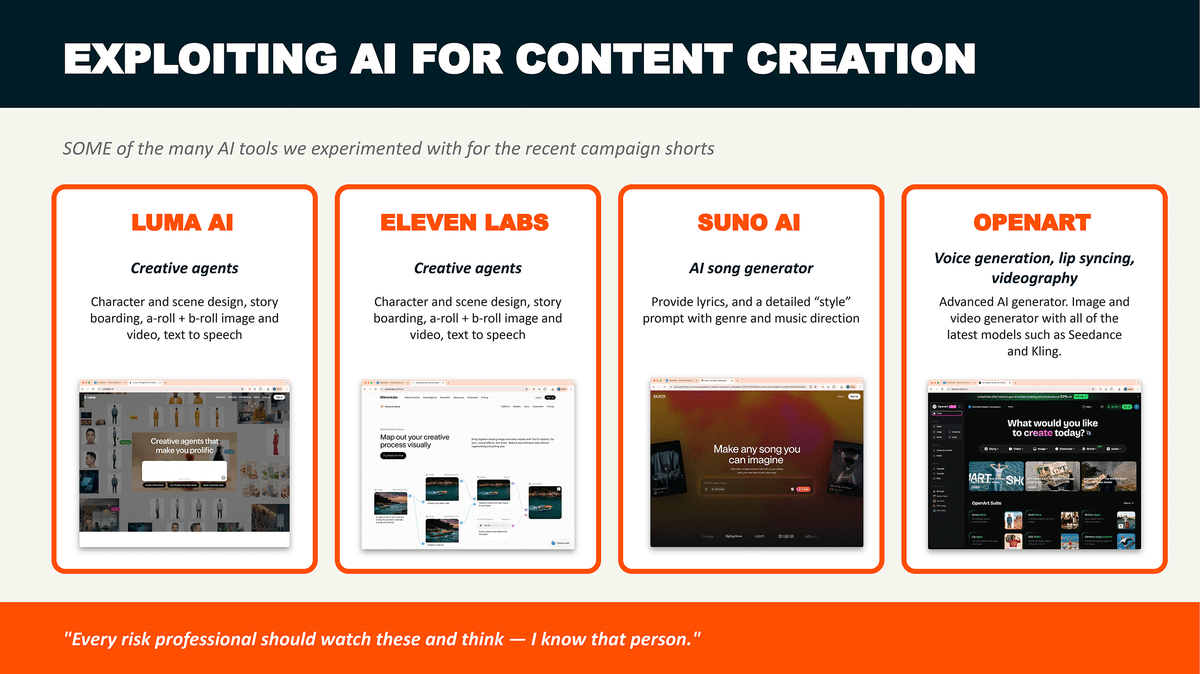
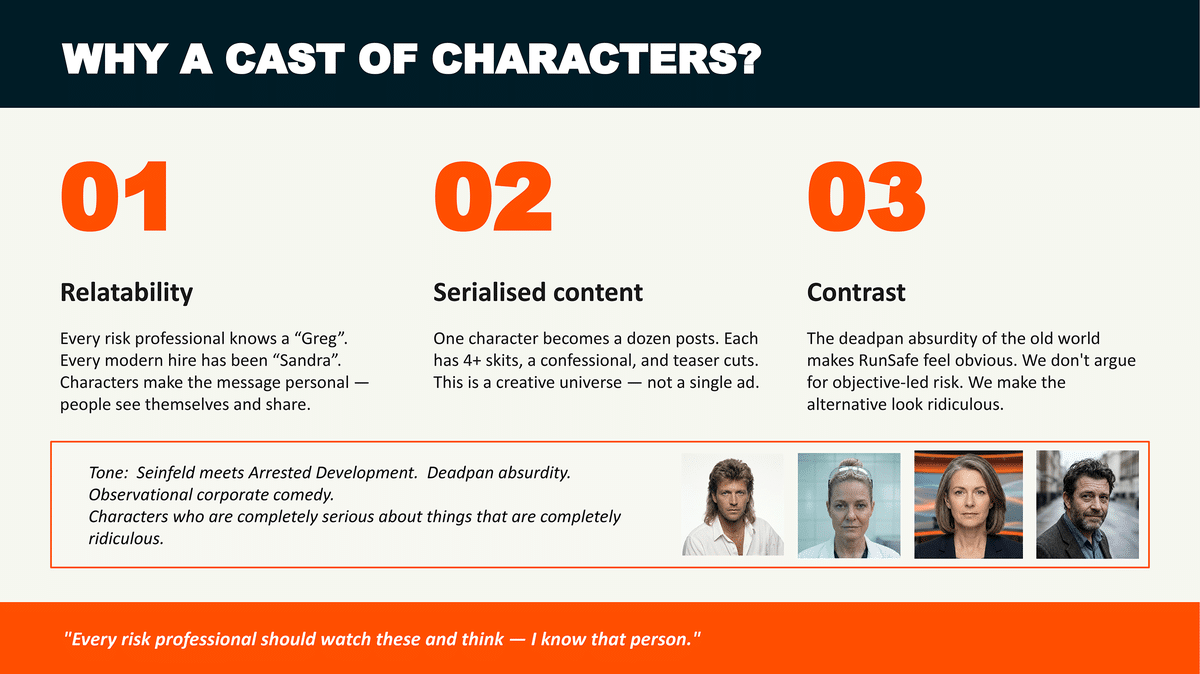
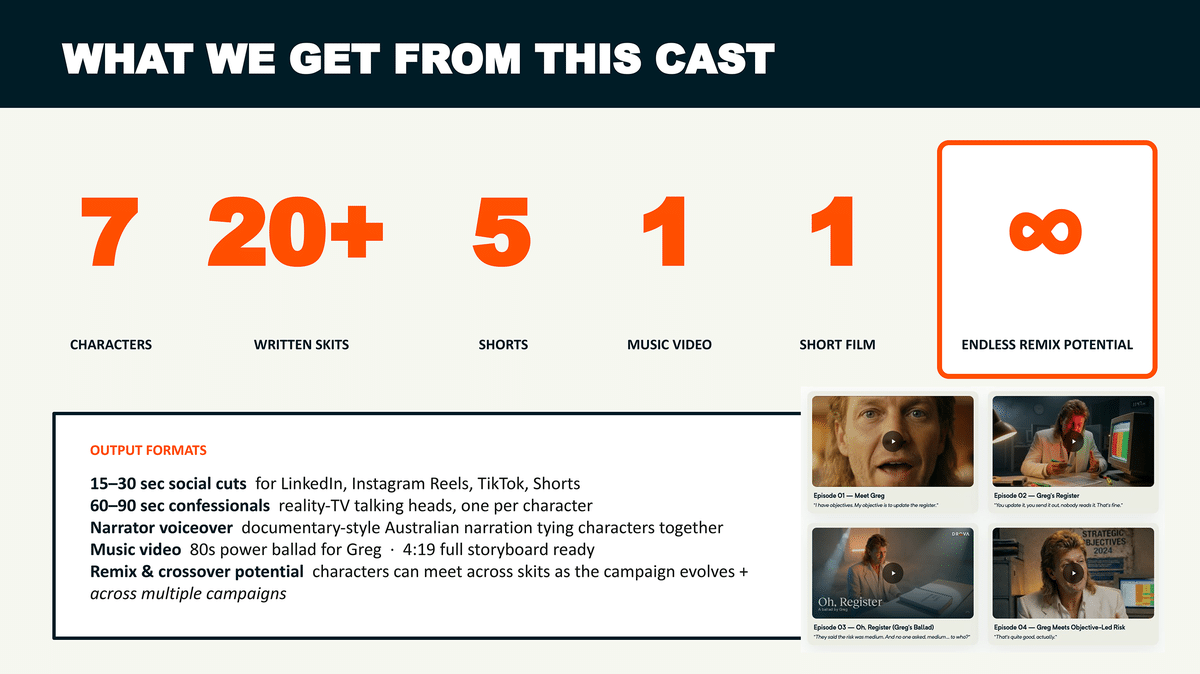
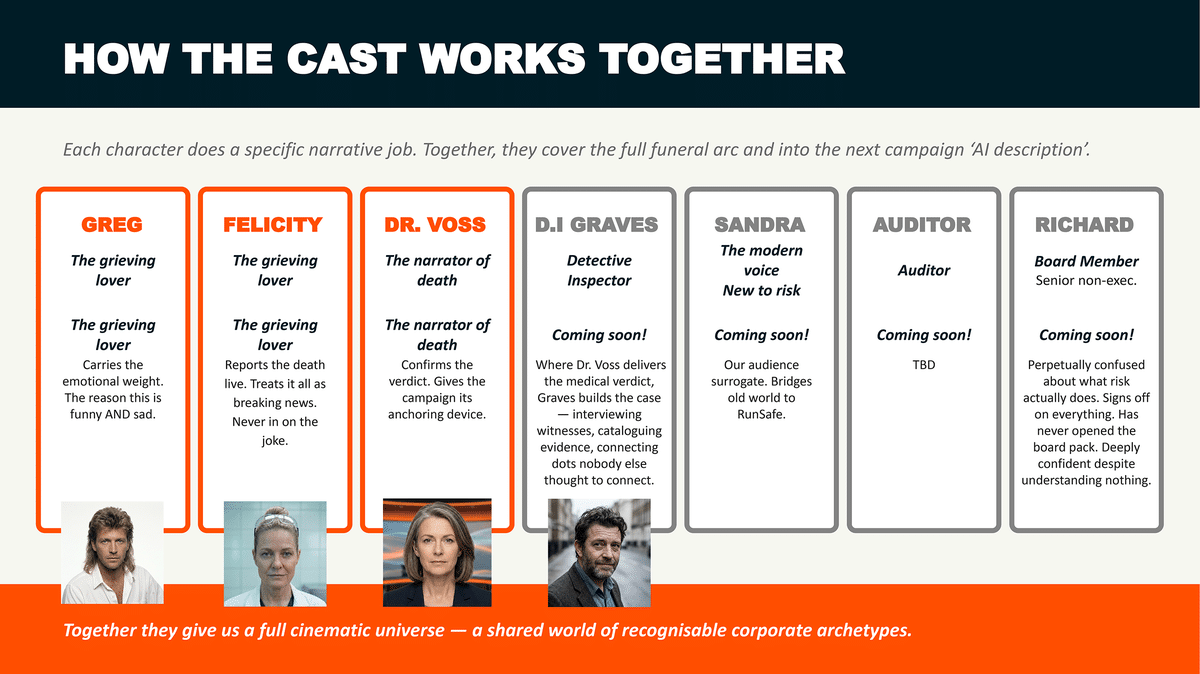
Sharing the how, not just the result, is deliberate. The point was never one clever video. It was a repeatable way of making them, owned by the whole team, rather than locked in my head.
The outcome
The Greg video (Apr 15) produced 779 views against 533 impressions: it was reshared beyond followers, which means it travelled. CTR of 15.95%. Engagement rate of 19.89%. Best-engaging single video of the campaign.
Autopsy document (Apr 13, LinkedIn): 17,870 impressions, 1,047 clicks, 14 of the campaign’s first 16 follows. The document, not the video, was the initial viral engine.
Email 1 (Apr 13): 17,985 sends, 25.64% open rate. Email 2 (Apr 17): 116.5K sends, 36.13% open rate. The second email, sent four days later, went to six times more people and opened at a higher rate.
Total LinkedIn impressions by Apr 15: 26,763, with a further 3,500+ on the Apr 17 Dr. Voss launch posts. LinkedIn followers gained across the campaign window: +120, compared to +16 at the Apr 15 mid-point. Site: 23,092 pageviews, 22,299 unique visitors on /in-loving-memory.
The structural outcome is a content system capable of eight-plus weeks of daily output across LinkedIn, Instagram, Facebook, and YouTube, built from a cast of seven characters across five formats, with an AI production pipeline that meant none of it required a traditional production team.
What I learned
Coming with the work changes the conversation.
When I walked into the pitch with two Greg shorts and a music video already built, the question stopped being “should we do this” and became “how do we ship this.” That is not a small difference. Pitching an idea invites people to evaluate whether it could work. Showing the thing forces a more honest response: does it work or doesn’t it. In this case it did, and everyone in the room knew it immediately.
The broader lesson is one I keep relearning: the gap between a good campaign and one that travels is almost always a person. Not a concept, not a format, not a clever line. A person the audience can stand next to for a moment and think: yes, that’s exactly it. Greg is that person for every risk professional who has ever sent out a report nobody read and told themselves that’s not the point. He’s not a caricature of someone else. He’s a mirror. That’s why he got reshared.
This case study covers my contribution to the In Loving Memory campaign for Drova / RunSafe, 2026: the character system, Greg’s arc, “Oh Register,” the social shorts strategy, and the cast expansion.
Leave a Reply